Monday, February 22, 2010

The Palo Verde tree


The best thing about most drought tolerant/desert xeriscape trees, shrubs and ground-covers is that because they have adapted to such harsh environments that the desert southwest offers they are generally easy to grow and nearly maintenance free. I say "nearly" because in all reality there is no such thing as a completely maintenance anything. No matter what type of vegetation we may be dealing with there will be periods when they need some type of care.

One such tree however that needs relatively little care and maintenance is the Palo Verde tree - a must for any southwestern/desert style landscape. Palo Verde's, Parkinsonia (Cercidium) spp, are not only tough they are absolutely reliable performers and require little, if any, direct water once established. They are also very fast growers that can quickly provide light, filtered shade cover.

These trees are native to virtually all of the desert southwest , from California to Texas and northern Mexico. Hence the different species such as the Mexican Palo Verde, Blue Palo Verde and the Yellow or Foothill Palo Verde. There is also a hybridized version of Palo Verde, Parkinsonia ‘Desert Museum’ which has extremely favorable characteristics for landscape use and has steadily become the preferred specified cultivar for many landscape architects and designers.

Palo Verde's generally grow 15 to 20 feet tall but can occasionally reach higher, sometimes close to 30 feet. Sometimes spread can be as much as twice that of the height. This should definitely be considered especially if the trees are direct watered. If not then the spread will usually be slightly less. The tree is deciduous and will drop its leaves in the fall. One interesting note about the adaptability of the tree is that in extremely dry conditions the tree will shed its leaves yet continue to photosynthesize because of the chlorophyll stored in its trunk and branches. The tree is usually hardy to 10 to 15 degrees and may even endure lower temperatures.

The leaf size and structure of the Palo Verde depends on the species. The tree produces a very delicate pale yellow flower in great abundance which is indeed quite striking to behold. Palo Verde's produce woody seed capsules which are four to six inches long. These mature in mid to late summer. Excepting for the hybrids the tree produces an extremely sharp thorn that prevents any desire to climb the tree.

Thursday, February 18, 2010

Don't blame the grass...II

In a previous blog, “Don’t Blame the Grass”, based on a recent article from the San Jose Mercury News was in response to how some Bay Area communities may possibly begin restricting lawn sizes.

Articles such as these seem to be the norm these days as the environmental effects of lawn care and maintenance, whether a residential space or a large expanse of lawn, continues to be a hot topic.

Just a few days ago I read another article on the Science Daily web site about a recent study conducted by researchers from the University of Irvine titled, “Urban 'Green' Spaces May Contribute to Global Warming.” The study attempts to make the point that large lawn turf areas, such as those found in urban parks, actually contribute negative effects towards ‘global greenhouse gases’ [sic] and the study even goes so far as to make the claim that, “..it is impossible for these lawns (large turf areas) to be net greenhouse gas sinks because too much fuel is used to maintain them.”

Now for those who don’t know a ’greenhouse gas sink’ is any large area of vegetation that has the ability to take carbon emissions and return those carbon emissions back into the earth. Previous studies have proven that large turf and vegetation areas actually have a positive effect on the earth and it’s eco-systems because these green areas do in fact have the ability to take carbon emissions and return them to the earth where they came from.

This brings up an interesting question then and that question is, So what's the solution?

The solution is simple and that solution doesn’t have to involve removing vast amounts of low lying greenery and vegetation that, in the long run, has a tremendous benefit not only on the environment but the overall quality of life that is enhanced by using and enjoying those vast open spaces.

That’s one thing that stuck me about the article frankly. It offered reasons why there are these perceived problems but it offered absolutely nothing in the way of solutions.

So what is the bottom line? I'll leave that for you to decide. I’m just a simple landscape designer taking up residence in the vast Mojave Desert. But I can say this and will continue to say this. Learn how to properly and effectively maintain not only the lawn turf that you may have in your landscape but also the other vegetation you may have in your landscape.

This is going to lead to a number of benefits. By properly maintaining your individual lawn space and the surrounding vegetation you will actually lower your water bill. Making sure your sprinkler system is properly timed and set at proper intervals in critical in providing effective irrigation to the landscape.

Pay close attention to the weather reports for your area and adjust or even shut off the irrigation system in relation to the anticipated weather. This simple practice can lead to preventing water waste so sprinklers don’t run on a rainy day. Fertilize your lawn with organic fertilizers not chemical based fertilizers. Have your lawn professionally aerated twice a year (spring/fall). This will promote and maintain healthy root growth.

Lastly, be prepared to share these suggestions with your friends and neighbors because, in the long run, everyone benefits from a well maintained lawn.

Sunday, January 31, 2010

Sustainable what?


I finally got an opportunity to watch “The Outdoor Room with Jamie Durie” yesterday and I must say I’m a bit perplexed by the term “sustainable landscape design” quite frankly. Now this post has nothing to do with Jaime’s design style or abilities, which unquestionably are considerable and well renowned. It’s at this point I have to admit I never heard of the guy until HGTV. My thoughts have everything to do with what constitutes the term “sustainable” especially in light of what I saw on the show yesterday.

The premise was creating an Australian styled outdoor room for a home in Duarte, California. In order to do this Jaime flew back to Australia for design ideas and inspiration from some of his previous design installations. This notion alone bothered me immensely because, after all, the man is from Australia! Does he really need to fly back and forth from California to Australia and back to California again just for design inspiration and to see in person how his designs are doing? Really? (OK, maybe he stopped by to say hi to mom and dad.) What makes this notion even more appalling is the fact that is TV – all this is “done for show.” Couldn’t he have just asked a buddy to email him some photos from the garden he did? I mean think of the jet fuel waste and air pollution alone of this one fact finding flight and how it could have been avoided. Ah, TV.

I have to say that I have never been to Australia and yet, if I want or need Australian inspiration for a garden design, I can just whip-out my handy, dandy Sunset Garden Guide and find literally hundreds of Australian natives – many readily available right here in So Cal from locally based wholesale nurseries. That being said this is California after all, not Australia. Wouldn’t the notion of using California or Southwestern natives be more in keeping with the whole notion of “sustainable”? I think it would be frankly.

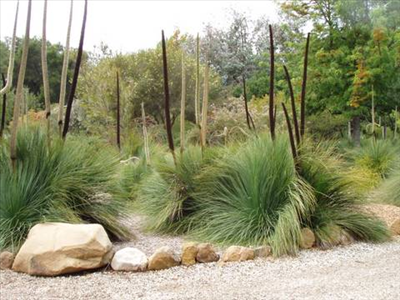
My next thought has to do with the quandary (contrived or not I can’t say) regarding the shows horticulturists’ mission to find an Australian Grass Tree, Xanthorrhoea preissii. She managed to drive to three different supply centers/nurseries to find this plant and couldn’t find any. She did in fact finally find one. Question: Is it more sustainable and thus better for the environment to frantically scurry about in a Toyota Pirus (as opposed to normally aspirated gas hog) than it would be to simply look up the plant on the internet? It took me all of two seconds to find the plant on the internet and confirm its availability not too terribly far from Duarte! Personally I don’t think this lump of grass-like leaves holds a candle to the Mexican Grass Tree, Nolina longifolia, but hey, that’s just me.

My last thought regarding the show and this misuse of the term “sustainable was the use of “rammed earth walls”. The whole notion of these walls was to create sustainable design by using extremely compacted earthen walls as raised planters for the wonderful assortment of Australian natives used in the landscape. After finally finding a contractor familiar with the technique (because after all [snide remark alert] we build so many of these earthen walls in So Cal) of building these walls a concrete truck is called into pour the footings. This is where I began to think that it simply would have made more sense just to use poured-in-place concrete walls with colored concrete and rough finished but hey, what do I know? Once the footings were in place and the forms for these rammed earth walls were done the use of motorized (two stroke engine) tampers was employed. So how is this technique more sustainable than just simply using one truck and one pour? It just seems to me that while it may be “chique” to want to use these types of walls from a sustainability aspect (I guess because the technique is cool or whatever) the technique used to install them is hardly more sustainable, earth friendly, environmentally conscientious (insert your favorite “green earth” term here) than just using P-I-P concrete walls.

Then I read on the HGTV web site that Jaime “In addition to being an award-winning designer and TV host, Jamie also is an advocate for preserving our natural surroundings and environmental future. He trained with former Vice President Al Gore as a Climate Change Ambassador and regularly participates in environmental lectures around the world.”

Oh, well that says it all then, he’s part of the “do as I say, not as I do crowd”.

Thursday, January 28, 2010

Don't blame the grass....


Recently I read an article that was posted on the California Landscape Contractors Association page at LinkedIn from the San Jose Mercury News regarding Bay Area communities possibly restricting lawn sizes. This has led to lively discussion and in fact has now blossomed into two separate conversations on this topic.

It seems that grass (or lawn turf if you prefer), in many cases, gets a bad rap and has become the environmentalist's equivalent of Quasimodo when in reality everything about a healthy lawn boils down to overall care. It matters not whether it's the front yard patch of lawn or the monstrous expanse of lawn turf at the local park green-scape maintenance is key to a healthy lawn.

For example, we recently experienced five straight days of heavy rain in Southern California from cyclical phenomenon known as El Nino yet how many folks paid enough attention to the weather report and shut off their irrigation systems? From the reaction I have seen from other designers and landscapers some did not.

That said however how many folks that have a lawn and pay good money to water it, even in the rain, have it professionally aerated and properly fed twice a year? I'm guessing relatively few. How many have the auto irrigation system set to water less days but properly timed for longer watering intervals? I'm guessing relatively fewer. How many have an automatic rain sensor? I'm guessing even fewer. How many even know the type of lawn they have in their yard? Even fewer still.

Ah, but how many consistently mow the lawn too short? Um, I'm going to guess most!

Questions like these illustrate that in all reality the problem is not the lawn but how it is watered, maintained and cared for that’s the real issue. And I'm certain that turf grass managers of all types will most likely tell you this is not just an issue with private homeowners but municipalities and recreation districts worldwide.

Before governments make any drastic decisions regarding private homeowners and their lawn issues revolving around proper maintenance and care should be discussed. The American Lawn Care Industry reminds us that a 50'x50' area of typical backyard lawn turf produces enough oxygen for a family of four for a year. This is important to keep in mind when discussing the environmental impact of having a well maintained lawn. The ALCI goes on to state that a properly maintained and cared for lawn offers many environmental benefits among which are the benefits of the cooling effects of lawn turf around homes and neighborhoods. Just eight average healthy front yard lawns have the same cooling effect of 70 tons of air conditioning - enough for 16 average homes!

Then there are the unseen benefits of pollution control. Dust and smoke particles from the atmosphere are trapped by blades of grass. Just like other plants lawns also convert carbon dioxide to oxygen. Lawns also help with overall water quality. A dense, healthy lawn turf slows down and filters runoff, removes contaminants and prevents soil and the contaminants from running off into drainage systems as well.

It seems to me in our efforts to worship at the alter of the cult of "Mother Earth" and almost deify the issue of "global warming" that we have failed to see the forest through the trees when it comes to understanding the importance of lawn turf.

In order to achieve a healthy lawn proper and consistent maintenance and watering are vital. I would suggest that one of the best and certainly one of the most underutilized aspects of proper lawn care involves professional aeration. Just like golf courses do as part of there regular maintenance programs the average residential lawn will benefit greatly from aeration. Aeration cores about 2 inches of soil from the lawn which relieves build-up compaction. This also allows water and oxygen to reach the root level of the lawn. This is very advantageous to a healthy lawn. It also makes fertilizing the lawn extremely effective and it minimizes runoff.

Yet the overall cost a residential aeration service is relatively inexpensive and even downright reasonable when one considers the overall benefits to the lawn of a twice yearly aeration and fertilizing program. In time the lawn will thrive and be much more healthy with regular aeration. This type of information regarding lawn care and maintenance needs to be at the forefront of our thoughts regarding the sustainability of lawn turf.

For example what is cost/benefit trade-off for both the homeowner and the environment in removing a particular amount of lawn turf and replacing it with other forms of ground cover and whether that ground cover is organic or not? I feel questions like these need to be answered by governments and municipalities before any specific approach regarding lawn turf can be recommended.

Tuesday, January 5, 2010

2010 Perennial Plant of the Year ™


The Perennial Plant Association has named it's 2010 Perennial Plant of the Year ™ and the winner is: Baptisia australis.

According to the associations web site
Blue false indigo grows three to four feet tall and three to four feet wide in an upright habit. This exceptional perennial grows across a wide range of zones and is one of the most adaptable native species.

Newly emerging shoots produce violet-blue, lupine-like flowers in erect 10- to 12-inch racemes atop flower stems extending well above the foliage mound of clover-like, trifoliate, bluish-green leaves. The spring flowers are present for three to four weeks. The flowers give way to inflated seed pods which turn charcoal black when ripe and which flower arrangers consider to be ornamental. The common name, blue false indigo, refers to the use of this perennial by early Americans as a dye.

Baptisia australis is an excellent plant to anchor the back of the border. It is also valuable for cottage gardens, native plant gardens, and native area of prairies and meadows. It is best as a specimen or planted in small groups. Blue false indigo can be used with bulbs and other spring flowering perennials to make interesting combinations.
  • Light - Plants thrive in full sun. Plants grown in partial shade may require staking.
  • Soil - This North American native is easily grown in well-drained soil and is drought tolerant after establishment.
  • Uses - This spring flowering shrub-like perennial may be used to fill the back of the border or in the wild garden.
  • Unique Qualities - The combination of flower and leaf color is dramatic in the early blooming season. Flowers are followed by inflated seed pods that are useful for dried flower arrangements.
  • Hardiness - USDA zones 3-9

Thursday, December 31, 2009

Happy New Year folks! Now, go get those pruning shears!

Yep, that's right go get those pruning shears and get busy....if you have roses that is. So in honor of the Rose Bowl and the Tournament of Roses Parade here's a few tips on pruning roses.

I can't tell you who gave me this piece of advice when I first moved to the High Desert but someone gave me a tip that the best time to prune roses was right after the 1st of the year. Why? Well for one I was told that if pruned too early roses could possibly begin to leaf out too early which could lead to possible damage and inferior flower production due to the freezes we get here. Now how true this is I couldn't say. I can say I've never done it any other way. So I honestly don't know how true this really is. But I can also say this, in all my years of living in the desert and taking care of roses this way I have never had a problem with any rose bush I've ever grown. They have always produced healthy blooms in great abundance.

But it's more than just the timing when to prune, it's how to prune. Roses love to be pruned so you should never be afraid you are cutting them too much. In fact you can always tell when a rose bush is neglected because they just begin to look sickly and straggly. Oh and a brief side note: The only time I would say not to trim roses is in that dormant period of mid summer when roses are at rest, catching the breath for fall bloom. Do this trimming in late spring after the last bloom.

Make sure that the canes to be pruned are cut to about a foot above the bud union, which is the junction of the canes and the shank. Do this with all the "strong" canes. These canes are quite thick, robust and very healthy looking. They have a good color to them. Dark with a bright reddish hue. Make sure you cut out completely any "weak" canes which are usually quite thin and discolored. Make sure you always cut strong canes at a 45 degree angle about a have inch above all nodes. The node is that part of the cane that looks a little like your knuckle and usually will have an even darker reddish hue compared to the rest of the cane. You don't need to be nearly as precise when thinning undesirable growth.

Cut out all "cross-over" canes as well. Those are canes that cross-over the strong canes or grow towards the center of the plant. Also cut out all what are called "redundant canes". These are canes that are usually more thin and grow adjacent (parallel) to the strong canes. It really is this simple to prune roses. Oh, and don't forget the most important thing. Wear gloves! Make sure you wear good gloves preferably leather to avoid all those nasty pricks and scrapes you can get from pruning roses. Follow these simple steps and you too will be rewarded with healthy growth and abundant blooms in the spring.