I finally got an opportunity to watch “The Outdoor Room with Jamie Durie” yesterday and I must say I’m a bit perplexed by the term “sustainable landscape design” quite frankly. Now this post has nothing to do with Jaime’s design style or abilities, which unquestionably are considerable and well renowned. It’s at this point I have to admit I never heard of the guy until HGTV. My thoughts have everything to do with what constitutes the term “sustainable” especially in light of what I saw on the show yesterday.
The premise was creating an Australian styled outdoor room for a home in Duarte, California. In order to do this Jaime flew back to Australia for design ideas and inspiration from some of his previous design installations. This notion alone bothered me immensely because, after all, the man is from Australia! Does he really need to fly back and forth from California to Australia and back to California again just for design inspiration and to see in person how his designs are doing? Really? (OK, maybe he stopped by to say hi to mom and dad.) What makes this notion even more appalling is the fact that is TV – all this is “done for show.” Couldn’t he have just asked a buddy to email him some photos from the garden he did? I mean think of the jet fuel waste and air pollution alone of this one fact finding flight and how it could have been avoided. Ah, TV.
I have to say that I have never been to Australia and yet, if I want or need Australian inspiration for a garden design, I can just whip-out my handy, dandy Sunset Garden Guide and find literally hundreds of Australian natives – many readily available right here in So Cal from locally based wholesale nurseries. That being said this is California after all, not Australia. Wouldn’t the notion of using California or Southwestern natives be more in keeping with the whole notion of “sustainable”? I think it would be frankly.

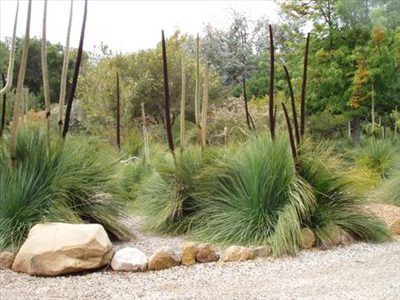
My next thought has to do with the quandary (contrived or not I can’t say) regarding the shows horticulturists’ mission to find an Australian Grass Tree, Xanthorrhoea preissii. She managed to drive to three different supply centers/nurseries to find this plant and couldn’t find any. She did in fact finally find one. Question: Is it more sustainable and thus better for the environment to frantically scurry about in a Toyota Pirus (as opposed to normally aspirated gas hog) than it would be to simply look up the plant on the internet? It took me all of two seconds to find the plant on the internet and confirm its availability not too terribly far from Duarte! Personally I don’t think this lump of grass-like leaves holds a candle to the Mexican Grass Tree, Nolina longifolia, but hey, that’s just me.
My last thought regarding the show and this misuse of the term “sustainable was the use of “rammed earth walls”. The whole notion of these walls was to create sustainable design by using extremely compacted earthen walls as raised planters for the wonderful assortment of Australian natives used in the landscape. After finally finding a contractor familiar with the technique (because after all [snide remark alert] we build so many of these earthen walls in So Cal) of building these walls a concrete truck is called into pour the footings. This is where I began to think that it simply would have made more sense just to use poured-in-place concrete walls with colored concrete and rough finished but hey, what do I know? Once the footings were in place and the forms for these rammed earth walls were done the use of motorized (two stroke engine) tampers was employed. So how is this technique more sustainable than just simply using one truck and one pour? It just seems to me that while it may be “chique” to want to use these types of walls from a sustainability aspect (I guess because the technique is cool or whatever) the technique used to install them is hardly more sustainable, earth friendly, environmentally conscientious (insert your favorite “green earth” term here) than just using P-I-P concrete walls.
Then I read on the HGTV web site that Jaime “In addition to being an award-winning designer and TV host, Jamie also is an advocate for preserving our natural surroundings and environmental future. He trained with former Vice President Al Gore as a Climate Change Ambassador and regularly participates in environmental lectures around the world.”
Oh, well that says it all then, he’s part of the “do as I say, not as I do crowd”.